{"commentics_url":"\/\/www.intelligencetest.com\/comsys\/","page_id":381,"enabled_country":false,"country_id":0,"enabled_state":false,"state_id":0,"enabled_upload":false,"maximum_upload_amount":3,"maximum_upload_size":5,"maximum_upload_total":5,"securimage":false,"securimage_url":"\/\/www.intelligencetest.com\/comsys\/3rdparty\/securimage\/securimage_show.php?namespace=cmtx_381","cmtx_wait_for_comment":"cmtx_wait_for_comment","lang_error_file_num":"A maximum of %d files are allowed to be uploaded","lang_error_file_size":"Please upload files no bigger than %d MB in size","lang_error_file_total":"The total size of all files must be less than %d MB","lang_error_file_type":"Only image file types are allowed to be uploaded","lang_text_loading":"Loading ..","lang_placeholder_country":"Country","lang_placeholder_state":"State","lang_text_country_first":"Please select a country first","lang_button_submit":"Add Comment","lang_button_preview":"Preview","lang_button_remove":"Remove","lang_button_processing":"Please Wait.."}
Comments (7)
Sort By
Topic:matrices: pyramids
3/5 (6)
New
Pain
2
0
0
Dec 2025
Painsays...
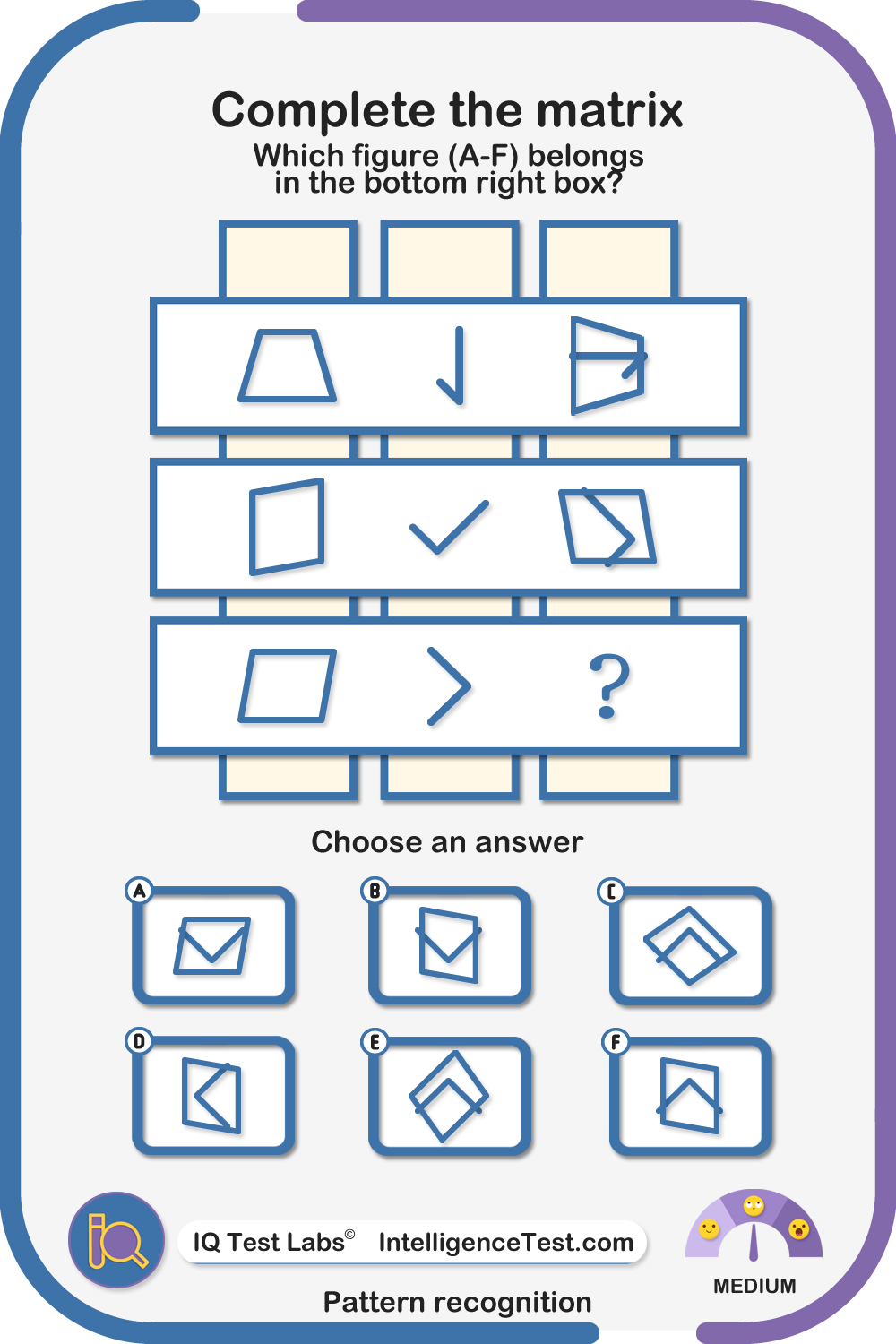
Isn't it 1st diagonal - 3rd diagonal = 2nd diagonal? Like a set theory subtraction.
Diagonal in the middle is the unknown, so let's check the other 2. We construct these other 2 diagonals by extending the matrix (kinda like in pacman, where the right side loops back to the left).
To start, we also have to identify the 4 distinct shapes: black triangle, wireframe triangle, solid inner circle and thin outer circle
- (1, 2), (2, 3), (3, 1) are:
thin outer circle & triangle + thin outer circle = thin outer circle + wireframe triangle
- (2, 1), (3, 2), (1, 3) are:
solid inner circle & triangle + solid inner circle = solid inner circle + wireframe triangle
As such, if we follow the pattern, then:
- (1, 1), (2, 2), (3, 3) are:
thin outer circle & solid inner circle & triangle + thin outer circle & solid inner circle = thin outer circle & solid inner circle & wireframe triangle
The solid triangle kinda "spreads" itself over the common shapes of the other 2.
So the way that I see it is that there always are symbols appearing twice and then theres one symbol only which only appears once. Wouldnt this mean that the right answer is F?
The only pattern I can find: there is 6 of each of the bigger circle sets, three of the smaller, three of each triangle. I find inconsistencies in all other patternes mentioned here.
Also, English is not my first language, but I don't understand what described circle set belongs to what set of circles. I see one set of small thin circles with lines attatched to them, one set of medium circles with thick lines, one set of large circles with thin lines. Why is one of them describes as concentric, and which one is that? Aren't all circles sets here part of a concentric shape/placement at some point in the matrix? Or are the concentric circles the ones cut by a line with the bigger outline disappearing in the first row because of alignment with a big circle? If so, why does the concentric circle appear in the first row? I thought it might be the effect fo the solid triangles, but then why do they also appear in the first column of the last row?
The independent circles and the outline circles are shown independently and concentrically in every row. So the third option in row three must be the concentric circles. Then you look at the triangles. They are never shown as concentric, so it must be B.
{"commentics_url":"\/\/www.intelligencetest.com\/comsys\/","page_id":381,"is_permalink":false,"lang_text_view":"View","lang_text_reply":"reply","lang_text_replies":"replies","lang_text_replying_to":"You are replying to","lang_title_cancel_reply":"Cancel this reply","lang_link_cancel":"[Cancel]","lang_text_not_replying":"You are not replying to anyone","lang_button_loading":"Loading..","lang_button_more":"More Comments","date_auto":true,"show_pagination":true,"pagination_type":"button","timeago_suffixAgo":"ago","timeago_inPast":"a moment","timeago_seconds":"less than a minute","timeago_minute":"a minute","timeago_minutes":"%d minutes","timeago_hour":"an hour","timeago_hours":"%d hours","timeago_day":"a day","timeago_days":"%d days","timeago_month":"a month","timeago_months":"%d months","timeago_year":"a year","timeago_years":"%d years"}





Comments (7)
Isn't it 1st diagonal - 3rd diagonal = 2nd diagonal? Like a set theory subtraction.
For this one, you have to look at diagonals.
Diagonal in the middle is the unknown, so let's check the other 2. We construct these other 2 diagonals by extending the matrix (kinda like in pacman, where the right side loops back to the left).
To start, we also have to identify the 4 distinct shapes: black triangle, wireframe triangle, solid inner circle and thin outer circle
- (1, 2), (2, 3), (3, 1) are:
thin outer circle & triangle + thin outer circle = thin outer circle + wireframe triangle
- (2, 1), (3, 2), (1, 3) are:
solid inner circle & triangle + solid inner circle = solid inner circle + wireframe triangle
As such, if we follow the pattern, then:
- (1, 1), (2, 2), (3, 3) are:
thin outer circle & solid inner circle & triangle + thin outer circle & solid inner circle = thin outer circle & solid inner circle & wireframe triangle
The solid triangle kinda "spreads" itself over the common shapes of the other 2.
So the way that I see it is that there always are symbols appearing twice and then theres one symbol only which only appears once. Wouldnt this mean that the right answer is F?
The only pattern I can find: there is 6 of each of the bigger circle sets, three of the smaller, three of each triangle. I find inconsistencies in all other patternes mentioned here.
Also, English is not my first language, but I don't understand what described circle set belongs to what set of circles. I see one set of small thin circles with lines attatched to them, one set of medium circles with thick lines, one set of large circles with thin lines. Why is one of them describes as concentric, and which one is that? Aren't all circles sets here part of a concentric shape/placement at some point in the matrix? Or are the concentric circles the ones cut by a line with the bigger outline disappearing in the first row because of alignment with a big circle? If so, why does the concentric circle appear in the first row? I thought it might be the effect fo the solid triangles, but then why do they also appear in the first column of the last row?
The independent circles and the outline circles are shown independently and concentrically in every row. So the third option in row three must be the concentric circles. Then you look at the triangles. They are never shown as concentric, so it must be B.